
As established soap making machine manufacturers, we understand that precision is the primary benchmark for operational excellence in today’s advanced industrial landscape. Whether you are formulating high-viscosity cosmetics, specialized pharmaceutical ointments, or advanced industrial coatings, the ability to achieve a homogeneous, clump-free dispersion is what defines product quality. At RS Soap Machine, we recognize that modern manufacturing demands more than just basic equipment; it requires sophisticated precision dispersion technology. We have engineered our triple roll mills to deliver the intense, controlled shear forces necessary to break down agglomerates into microscopic particles, ensuring your production line operates with surgical accuracy.
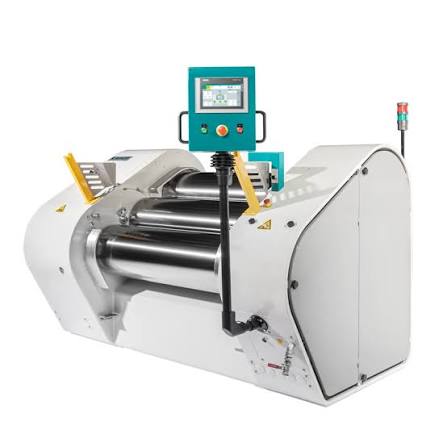
The Engineering Behind the Mill: The Science of High-Shear Processing
The operational efficacy of a professional triple roll mill lies in the synchronization of its three precision-ground rollers. As the material passes through the narrow gaps between the feeding, center, and delivery rollers, it is subjected to a graduated increase in rotational speed. This mechanical gradient generates extreme shear and compressive forces.
For engineers and production managers, this means more than just a smooth texture; it signifies the total control of particle size distribution. This consistency is critical for high-end applications, where even a micron-level deviation can affect the rheological properties of the final product.
Key Industrial Applications
Our triple roll mills are designed to meet the rigorous demands of diverse high-precision sectors:
Cosmetics & Personal Care: Achieving the perfect texture for luxury lipsticks and skincare emulsions.
Printing & Coatings: Ensuring pigment dispersion for high-concentration inks and conductive coatings to prevent printing defects.
Pharmaceuticals: Producing stable, uniform medicinal pastes and dermatological gels that meet strict regulatory standards.
Chemical Manufacturing: Processing specialized adhesives and polymers where material homogeneity is non-negotiable.
Comparative Engineering: Standard vs. Premium Industrial Series
When evaluating dispersion equipment, understanding the build quality is essential for long-term ROI. The following comparison highlights the engineering advantages of our Premium Professional Series:
Feature | Standard Series | Premium Professional Series |
Roller Material | Hardened Steel | Medical Grade Stainless Steel/Alloy |
Gap Adjustment | Manual Dial | Digital Micrometer Precision |
Cooling System | Air Cooled | Integrated Water Cooling Jacket |
Surface Finish | Polished | Mirror-Finish (Ultra-Smooth) |
Technical Specifications for Optimized Production
At RS Soap Machine, we believe in transparency regarding technical capabilities. A high-performance mill must offer the perfect balance of torque and tolerance. Our standard industrial units are engineered to handle high-viscosity pastes with ease, ensuring that your moisture-sensitive or heat-sensitive ingredients remain stable throughout the milling process.
Roller Diameter: 80mm - 150mm
Min. Gap Distance: 0.005mm (5 microns)
Motor Power: 2.2kW - 7.5kW (High-Torque)
Material Compatibility: Pastes, Gels, Viscous Industrial Chemicals
Maintenance and Operational Longevity
To maximize the lifecycle of your investment, a rigorous maintenance schedule is paramount. Because our mills operate at tight tolerances, even minor residue buildup can affect gap calibration. We recommend:
Non-Abrasive Cleaning: Preserve the mirror-finish of the rollers using industry-approved solvents.
Regular Calibration: Check the gap alignment at the start of every production shift using feeler gauges or digital micrometers.
Lubrication Management: Periodically service the gear assemblies to ensure consistent shear force delivery over years of operation.
Conclusion: Elevating Your Manufacturing Standards
Investing in a professional triple roll mill is a strategic commitment to product quality and process reliability. By leveraging high-shear dispersion technology, you ensure that every batch meets the exact specifications required by today’s demanding global markets.
Frequently Asked Questions (FAQs)
1. How does a triple roll mill differ from a colloid mill?
The distinction lies in the shear mechanism. A triple roll mill machine uses three-stage roller compression for extremely high-viscosity materials (pastes/inks), whereas a colloid mill utilizes a rotor-stator system better suited for lower-viscosity liquids and fluid emulsions.
2. Why is water cooling essential for industrial dispersion?
Intense shear forces generate significant mechanical heat. For heat-sensitive APIs, waxes, or chemical additives, this heat can trigger phase separation or degradation. Our integrated water-cooling jacket ensures the product remains within a stable temperature range.
3. How often should roller gaps be calibrated?
Calibration should be treated as a pre-shift standard procedure. Because even a few microns of deviation can result in clumping or inconsistent particle size, regular verification is the hallmark of a high-quality manufacturing facility.
4. Can RS Soap Machine assist with material selection?
Absolutely. As expert manufacturers, we guide our clients in choosing between hardened steel, ceramic, or 316L stainless steel rollers based on the abrasiveness and chemical reactivity of their specific production materials.